Income Inequality, Peace and Conflict: Do More Peaceful Countries Face Greater Risks from Rising Inequality?
Article Sidebar
Main Article Content
Abstract
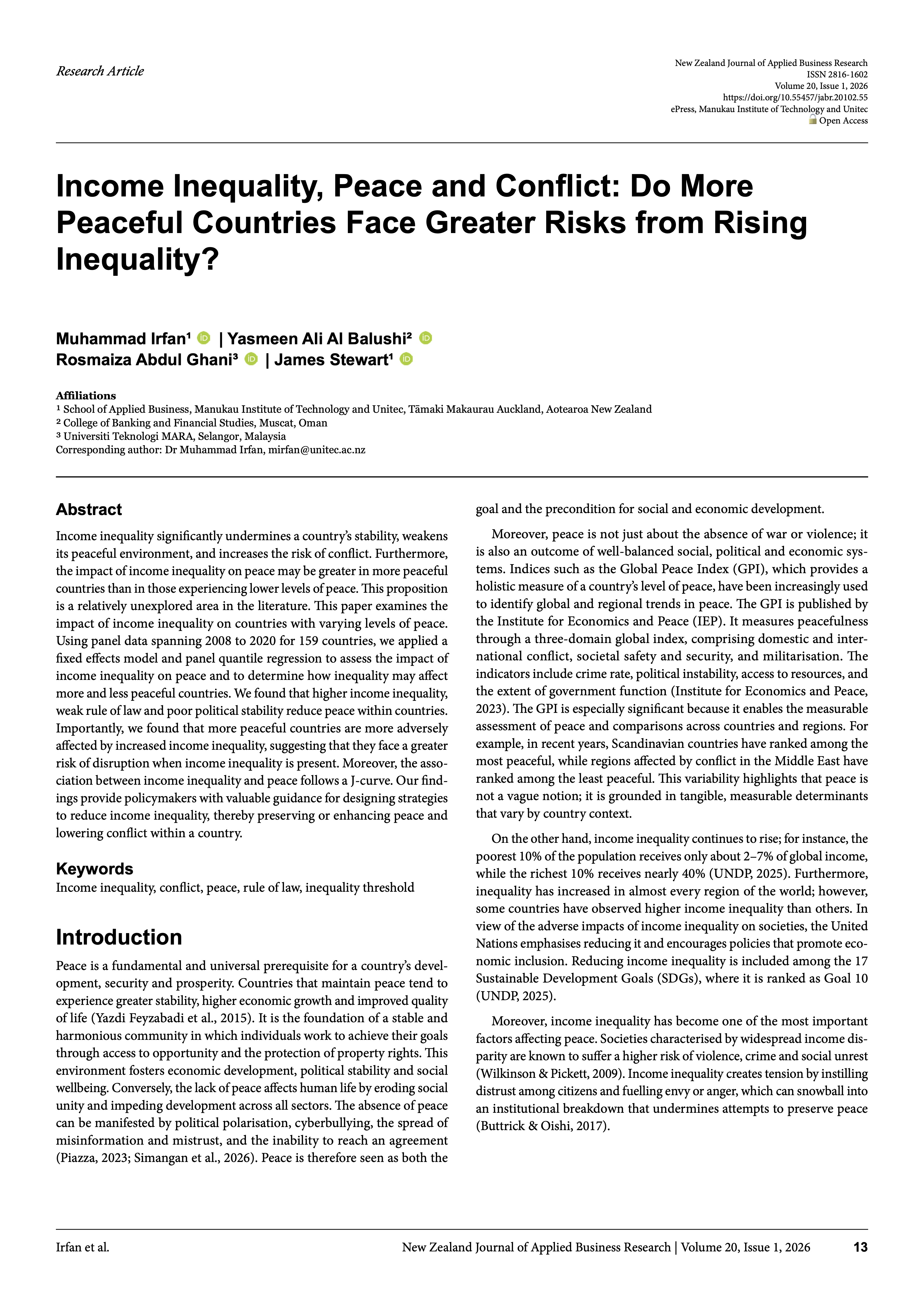
Income inequality significantly undermines a country’s stability, weakens its peaceful environment, and increases the risk of conflict. Furthermore, the impact of income inequality on peace may be greater in more peaceful countries than in those experiencing lower levels of peace. This proposition is a relatively unexplored area in the literature. This paper examines the impact of income inequality on countries with varying levels of peace. Using panel data spanning 2008 to 2020 for 159 countries, we applied a fixed effects model and panel quantile regression to assess the impact of income inequality on peace and to determine how inequality may affect more and less peaceful countries. We found that higher income inequality, weak rule of law and poor political stability reduce peace within countries. Importantly, we found that more peaceful countries are more adversely affected by increased income inequality, suggesting that they face a greater risk of disruption when income inequality is present. Moreover, the association between income inequality and peace follows a J-curve. Our findings provide policymakers with valuable guidance for designing strategies to reduce income inequality, thereby preserving or enhancing peace and lowering conflict within a country.
Article Details

This work is licensed under a Creative Commons Attribution-NonCommercial 4.0 International License.
Authors retain copyright ownership of their work. NZJABR owns copyright in the final formatted and published version of the authors’ work.
Articles published in NZJABR since 1 December 2023 are published under a Creative Commons Attribution NonCommercial license 4.0 International. Readers have immediate free access to the articles and are permitted to read, download, copy, distribute, print, search, or link to the full texts of articles, crawl them for indexing, pass them as data to software, or use them for any other lawful purpose, provided that:
- They must give appropriate credit to the authors, and to NZJABR as first publisher, provide a link to the license, and indicate what changes if any they have made, while avoiding any suggestion that the authors or NZJABR endorse their use of the work.
- They may not use the content for commercial purposes.
Plaudit




References
Bhattacharya, S., & Paul, S. (2024). Progress of peace score and its association with the peace-constructing variables: An analysis in terms of regional and income class specification. In T. Chatterjee (Ed.), International trade, economic crisis and the Sustainable Development Goals (pp. 119–132). Emerald Publishing Limited. https://doi.org/10.1108/978-1-83753-586-620241008
Braun, M., Parro, F., & Valenzuela, P. (2019). Does finance alter the relation between inequality and growth? Economic Inquiry, 57(1), 410–428. https://doi.org/10.1111/ecin.12581
Buttrick, N. R., Heintzelman, S. J., & Oishi, S. (2017). Inequality and well-being. Current Opinion in Psychology, Inequality and Social Class, 18, 15–20. https://doi.org/10.1016/j.copsyc.2017.07.016
Buttrick, N. R., & Oishi, S. (2017). The psychological consequences of income inequality. Social and Personality Psychology Compass, 11(3), e12304. https://doi.org/10.1111/spc3.12304
Caruso, R., & Biscione, A. (2022). Militarization and income inequality in European countries (2000–2017). Peace Economics, Peace Science and Public Policy, 28(3), 267–285. https://doi.org/10.1515/peps-2022-0026
Castelló-Climent, A. (2010). Inequality and growth in advanced economies: An empirical investigation. The Journal of Economic Inequality, 8(3), 293–321. https://doi.org/10.1007/s10888-010-9133-4
Coccia, M. (2018). Violent crime driven by income inequality between countries (SSRN Scholarly Paper No. 3164079). Social Science Research Network. https://papers.ssrn.com/abstract=3164079
Della Posta, P. (2017). Economic inequality and conflicts: An overview. https://arpi.unipi.it/handle/11568/1041654
Djailani, S. A., & Surwandono. (2023). The wealth–peace connection: Human Development Index and Global Peace Index in Middle Eastern nations. Jurnal Politik Profetik, 11(1), Article 1. https://doi.org/10.24252/profetik.v11i1a5
Doğan, N. (2019). Determinants of global peace and gender equality as an invisible hand: A cross country analysis. Kadın/Woman 2000, Journal for Women’s Studies, 20(2), Article 2. https://doi.org/10.33831/jws.v20i2.80
Dorling, D. (2012). Inequality constitutes a particular place. Social & Cultural Geography, 13(1), 1–10. https://doi.org/10.1080/14649365.2011.635250
Dossou, T. A. M., Kambaye, E. N., Berhe, M. W., & Asongu, S. A. (2023). Moderating effect of ICT on the relationship between governance quality and income inequality in sub-Saharan Africa. Information Development, 02666669231170396. https://doi.org/10.1177/02666669231170396
Ezcurra, R. (2019). Interregional inequality and civil conflict: Are spatial disparities a threat to stability and peace? Defence and Peace Economics, 30(7), 759–782. https://doi.org/10.1080/10242694.2018.1446621
Fajnzylber, P., Lederman, D., & Loayza, N. (2002). Inequality and violent crime. The Journal of Law and Economics, 45(1), 1–39. https://doi.org/10.1086/338347
Fearon, J. D., & Laitin, D. D. (2003). Ethnicity, insurgency, and civil war. American Political Science Review, 97(1), 75–90.
Freeman, S. (2018). The current global reality: Poverty and income inequality. Seminars in Pediatric Neurology, Social Pediatric Neurology, 27, 1–9. https://doi.org/10.1016/j.spen.2018.03.001
Ghazalian, P. L., & Hammoud, M. (2021). The peace level of nations: An empirical investigation into the determining factors. Defence and Peace Economics, 32(5), 509–532. https://doi.org/10.1080/10242694.2020.1743957
Hillesund, S., Bahgat, K., Barrett, G., Dupuy, K., Gates, S., Nygård, H. M., Rustad, S. A., Strand, H., Urdal, H., & Østby, G. (2018). Horizontal inequality and armed conflict: A comprehensive literature review. Canadian Journal of Development Studies / Revue Canadienne d’études Du Développement, 39(4), 463–480. https://doi.org/10.1080/02255189.2018.1517641
Institute for Economics and Peace. (2023). Global Peace Index 2023. https://www.economicsandpeace.org/wp-content/uploads/2023/09/GPI-2023-Web.pdf
Ippolito, M., & Cicatiello, L. (2019). Political instability, economic inequality and social conflict: The case in Italy. Panoeconomicus, 66(3), Article 3. https://doi.org/10.2298/PAN1903365I
Justino, P. (2019). Governance interventions in conflict-affected countries. The Journal of Development Studies, 55(7), 1364–1378. https://doi.org/10.1080/00220388.2018.1487053
Khatun, F., & Saadat, S. Y. (2021). The optimum level of income inequality in South Asia: An econometric analysis. South Asia Economic Journal. https://doi.org/10.1177/13915614211039087
Kochan, T. A., & Riordan, C. A. (2016). Employment relations and growing income inequality: Causes and potential options for its reversal. Journal of Industrial Relations, 58(3), 419–440. https://doi.org/10.1177/0022185616634337
Korkut Pata, U., Yilanci, V., Hussain, B., & Asif Ali Naqvi, S. (2022). Analyzing the role of income inequality and political stability in environmental degradation: Evidence from South Asia. Gondwana Research, 107, 13–29. https://doi.org/10.1016/j.gr.2022.02.009
Milanovic, B. (2016). Global inequality: A new approach for the age of globalization. Harvard University Press. https://doi.org/10.4159/9780674969797
Neckerman, K. M., & Torche, F. (2007). Inequality: Causes and consequences. Annual Review of Sociology, 33, 335–357. https://doi.org/10.1146/annurev.soc.33.040406.131755
Odusola, A. F., Cornia, G. A., Bhorat, H., & Conceição, P. (Eds.). (2017). Income inequality trends in sub-Saharan Africa: divergence, determinants and consequences. United Nations Development Programme, Regional Bureau for Africa.
OECD. (n.d.). Measuring well-being and progress. https://www.oecd.org/en/topics/sub-issues/measuring-well-being-and-progress.html
OECD. (2014, December 8). Trends in income inequality and its impact on economic growth. https://www.oecd.org/en/publications/trends-in-income-inequality-and-its-impact-on-economic-growth_5jxrjncwxv6j-en.html
Parsons, B., & Naghshpour, S. (2023). Panel data analysis of internal conflict and income inequality. European Journal of Government and Economics, 12(1), 79–101. https://doi.org/10.17979/ejge.2023.12.1.9283
Piazza, J. A. (2023). Political polarization and political violence. Security Studies, 32(3), 476–504. https://doi.org/10.1080/09636412.2023.2225780
Polacko, M. (2021). Causes and consequences of income inequality – An overview. Statistics, Politics and Policy, 12(2), 341–357. https://doi.org/10.1515/spp-2021-0017
Ravallion, M. (2014). Income inequality in the developing world. Science, 344(6186), 851–855. https://doi.org/10.1126/science.1251875
Richmond, O. P. (2014). The impact of socio-economic inequality on peacebuilding and statebuilding. Civil Wars, 16(4), 449–467. https://doi.org/10.1080/13698249.2014.985876
Simangan, D., Sharifi, A., Sarmento dos Muchangos, L., Candelaria, J. L., Jayaram, D., Marquardt, J., Nishio, J., Okitasari, M., Saberi, E., & Salazar, V. (2026). Mapping positive peace pillars and indicators in sustainable development research: Co-benefits, trade-offs, and mediating factors. Annual Review of Environment and Resources. https://doi.org/10.1146/annurev-environ-121124-013321
Sztaudynger, J. J. (2018). Economic growth and the optimal inequality of income. Annales. Etyka w Życiu Gospodarczym, 21(8), 89–99. https://www.ceeol.com/search/article-detail?id=765971
Tsui, A. S., Enderle, G., & Jiang, K. (2018). Income inequality in the United States: Reflections on the role of corporations. Academy of Management Review, 43(1), 156–168. https://doi.org/10.5465/amr.2016.0527
UNDP. (n.d.). Goal 10: Reduced inequalities. https://www.undp.org/sustainable-development-goals/reduced-inequalities
Wilkinson, R. G., & Pickett, K. E. (2009). Income inequality and social dysfunction. Annual Review of Sociology, 35, 493–511. https://doi.org/10.1146/annurev-soc-070308-115926
Yazdi Feyzabadi, V., Haghdoost, A., Mehrolhassani, M. H., & Aminian, Z. (2015). The association between peace and life expectancy: An empirical study of the world countries. Iranian Journal of Public Health, 44(3), 341–351. https://pmc.ncbi.nlm.nih.gov/articles/PMC4402412/